 FUDOSHEN
Who we are
Fudoshen is an independent, member-funded product for people who are serious about developing themselves. There are no ads and your data is never sold, so we answer to the people who use it.
About
We build the tools. You walk the path, one deliberate day at a time.
Fudoshen is an independent, member-funded product for people who are serious about developing themselves. There are no ads and your data is never sold, so we answer to the people who use it.
We lead people down their own path with one calm place to plan the day, practice daily, reflect on what happened and adjust. The work is yours; the system keeps it in front of you.
Twelve connected tools: Command, Tasks, Calendar, Habits, Focus, Journal and Notes, Growth, Money, Investing log, Analytics, Canvas and Community.
A searchable help center, a first-day guide, a weekly review that turns the week into one thing to keep and one to change, and your data downloadable in one file.
How small repetitions add up
Improve by just 1% a day and, compounded, you end the year about 38 times better than you started. Slip by 1% a day and you end near zero. Progress grows on a curve, which is why the first weeks feel slow and the later ones don’t.
An illustration of compounding, not a forecast. Fudoshen doesn’t promise any particular result.
Where the name comes from
Fudōshin is a principle of Japanese Zen and the martial arts. It describes a mind that stays steady under pressure, neither frozen nor scattered, so that action comes from clarity rather than fear. The name Fudoshen is our own spelling of it.
Swordsman, strategist and author, 1584–1645
Musashi fought dozens of duels and was never defeated. Late in life he withdrew to a cave and wrote The Book of Five Rings, a treatise on strategy that is still read by athletes, founders and soldiers, and Dokkōdō, twenty-one short rules for walking the way alone. His whole teaching comes down to one idea: the mind you bring to a fight is the mind you train every ordinary day. There is no separate practice for the hard moments.
The term fudōshin was given its clearest form by the Zen monk Takuan Sōhō, writing to the sword master Yagyū Munenori: a mind that does not stop on any one thing, and so can meet anything. Musashi lived it. We built a system to practice it.
From the first book of The Book of Five Rings, in our words. Each one maps to something in Fudoshen.
No tricks, no shortcuts, no lying to yourself about where you are.
Mastery is not decided once. It is practiced daily, for life.
Learn widely. Ways of thinking from one craft sharpen another.
Respect how other people work. Their discipline teaches you yours.
Judge what actually serves you, not what feels good in the moment.
Trust what you have trained to see. Act on it without hesitation.
Read patterns, not just events. The record shows what the moment hides.
A trifle is where the real work is. Nothing is too small to do well.
Cut what does not serve the path, however pleasant it looks.
How it shows up in the app
Habit streaks are counted in the stages of shu-ha-ri (守破離), the traditional path from following the form to transcending it, and the highest stage is named fudōshin. The daily output score, the weekly review and the focus timer are all built on the same belief: a steady mind is made from small, repeated, honest work, not from motivation.
Why this one sticks
Most apps fail on day one, because they ask you to build the system before they give you anything back. Fudoshen does it the other way round.
Answer three questions and Fudoshen builds your tasks and habit for today. You start with something to finish, not something to set up.
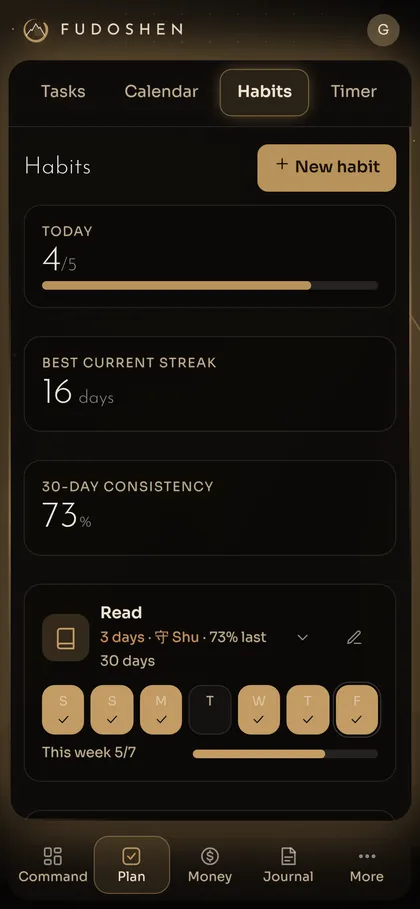
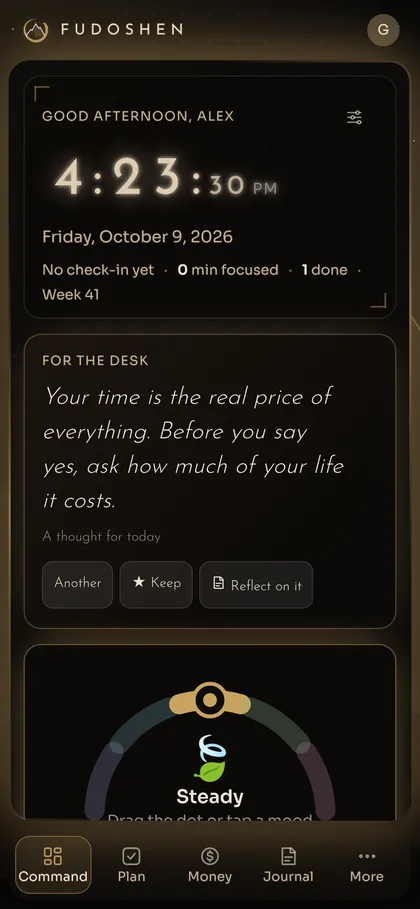
One screen for the day, a capture box that takes a task in one line, and habits you check off with one tap. Built for a phone in your hand.
Each week Fudoshen tells you what it noticed: when you focus best, which habit holds, which one slips. Only what your data supports.
Your tasks, calendar, habits, focus, journal and money share one record, so the week you review is the week you lived.
See it for yourself
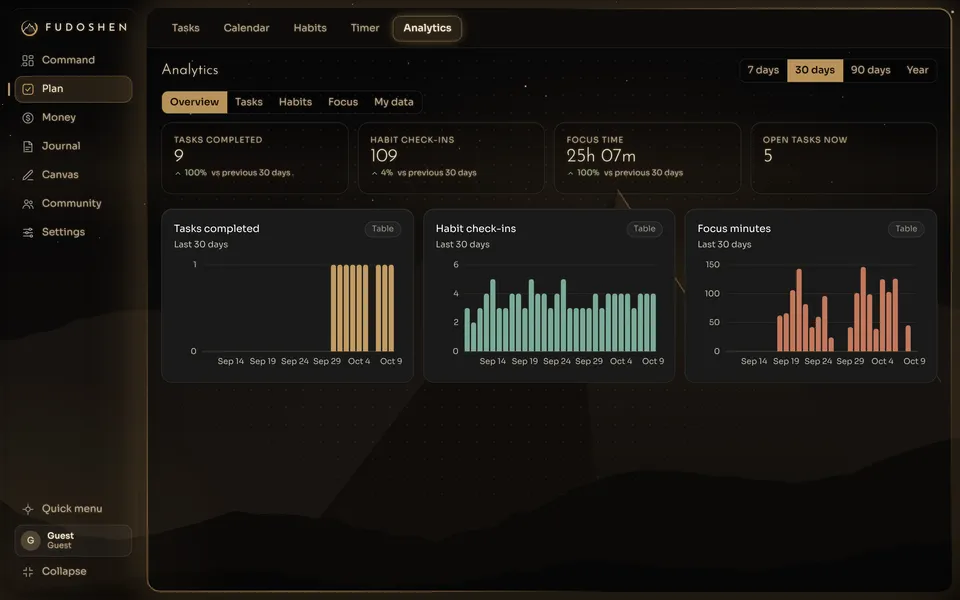
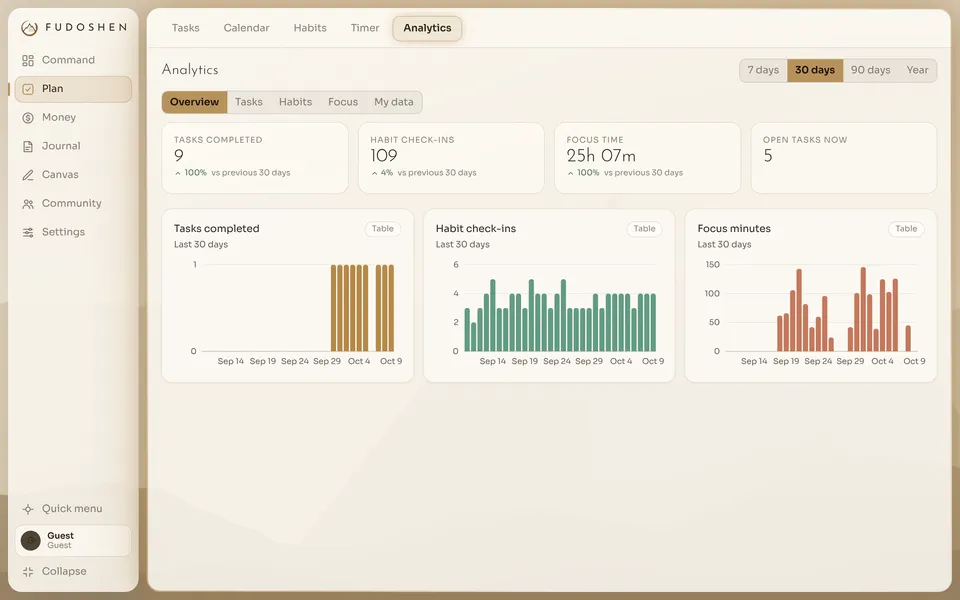
Dark or light, on your laptop or in your pocket. Fudoshen looks the way you set it up.
Why I built it
Tasks in one place, habits in another, money in Excel, notes all scrambled and scattered, scrolling to find them. My workspace was cluttered, nothing talked to anything else, and every few months I would start over in a new app and lose the record again. I was not short on intentions. I was short on one place that held them.
So I built Fudoshen for my own long-term vision first: one powerful resource to plan, track and manage every part of the climb, and to see it in one record so I could tell whether I was actually moving toward the destination or just staying busy. It had to work in fifteen minutes on a phone, and it had to make the small daily work add up to something I could see.
That is still what it is for. If it does not earn its place on your Home Screen, cancel from Account in two taps.
The founder, Fudoshen
You don’t need to become someone else overnight. You need a system that helps you practice becoming, one deliberate action at a time.